Predicting the preventable: Using machine learning to lower the risk of blood clots in patients with cancer
Robert Grant
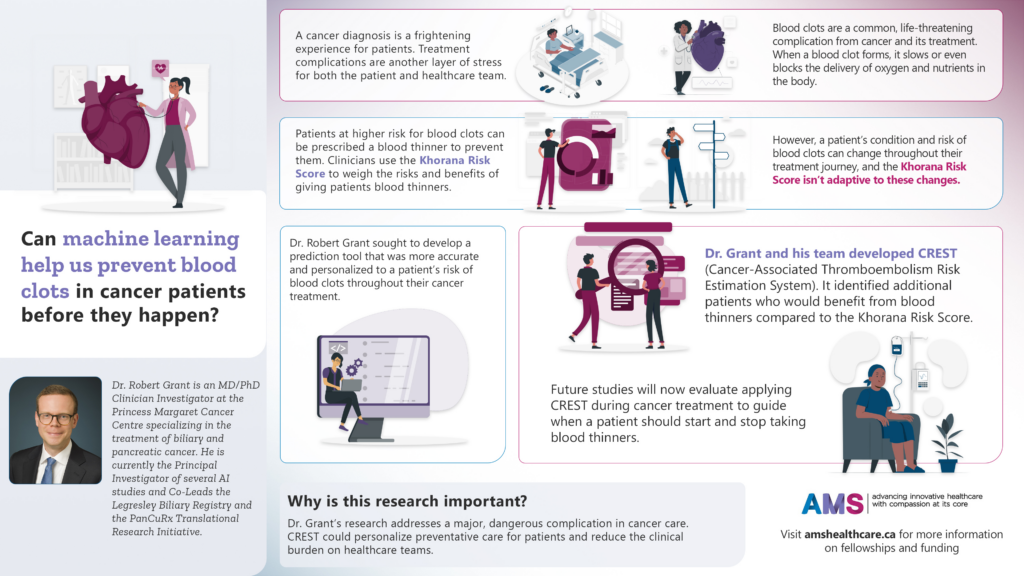
Navigating a cancer diagnosis is an overwhelming experience for a patient. The possibility of complications from treatments is an added layer of stress for both the patient and healthcare team. One common life-threatening complication from cancer treatments is blood clots. The blood vessels act like highways and streets that deliver oxygen and nutrients to every cell in the body. When a blood clot forms, it’s like a massive pile-up accident on a busy highway. Everything slows down, backs up, and oxygen and nutrients can’t reach its destination.
Fortunately, patients can be given blood thinners while undergoing treatment. A drawback of blood thinners is that patients are more likely to bleed and have difficulty stopping the bleeding. So, clinicians use the ‘Khorana Risk Score’ to calculate and weigh the risks and benefits of prescribing preventative blood thinners. However, a patient’s condition can change throughout their treatment journey, and the Khorana Risk Score isn’t responsive to these changes.
Dr. Robert Grant is a Medical Oncologist and Clinician Investigator at the Princess Margaret Cancer Centre who specializes in pancreatic and biliary cancers and a 2023 AMS Fellow in Compassion and Artificial Intelligence (AI). He wanted a tool that could more accurately predict a patient’s risk of developing a blood clot throughout their treatment compared to the static Khorana Risk Score.
“We wanted to use state-of-art machine learning approaches to get as accurate as possible risk prediction for cancer-associated thrombosis. But we wanted to do it in a dynamic way that responds to the patient’s entire treatment journey and see how it performs relative to the Khorana risk score,” he explained.
His team turned to AI and machine learning to build something personalized to a patient’s risk of blood clots during cancer treatment. They began by reviewing blood clots in radiology reports manually and later incorporated a large language model to identify the blood clots. Using existing patient data from the Princess Margaret Cancer Centre, they developed a machine learning model that could predict the risk of developing a blood clot during cancer treatment.
This new prediction model—Cancer-Associated Thromboembolism Risk Estimation System (CREST)—identifies additional patients who would benefit from blood thinners compared to the Khorana Risk Score. Also, CREST assesses risk throughout cancer treatment and could be used to guide when a patient should start and stop taking blood thinners.
“We are trying to move beyond just using machine learning to make predictions, but make predictions to optimize interventions for better personalized care,” said Dr. Grant.
CREST has the potential to address a major, dangerous complication in cancer care. It has opened the possibility for personalized preventative care for patients and their changing conditions during and after cancer treatments. For clinicians, CREST could help simplify and reduce the additional burden on clinicians when trying to determine a patient’s needs for blood thinners.
“I think if it’s implemented effectively within the workflow and electronic health record, it’ll be put at the top of mind. Many of the reasons why people probably aren’t on these medications right now is that there’s a lot going on when somebody has a new cancer diagnosis. It could be an additional prompt and discussion tool to bring to patients.”
Dr. Grant shared that the AMS Fellowship changed how he approaches AI and machine learning in its application in clinical settings. It provided the funding, resources, and community of experts to develop this project. Since his fellowship research, Dr. Grant is now working towards deploying CREST in real-time at Princess Margaret Cancer Centre. Afterwards, the goal is to co-design and evaluate the next version of CREST with the thrombosis team and patients so that it truly serves both clinicians and patients.
Dr. Robert Grant is an MD/PhD Clinician Investigator at the Princess Margaret Cancer Centre specializing in the treatment of biliary and pancreatic cancer, who is also affiliated with the Institute for Medical Science at the University of Toronto, ICES, and the Ontario Institute for Cancer Research. His research focuses on applying artificial intelligence to clinical and genomic data to improve outcomes for people with cancer. He is currently the Principal Investigator of several AI studies and Co-Leads the Legresley Biliary Registry and the PanCuRx Translational Research Initiative.
Read Dr. Robert Grant’s Publication:
He JC, Alghamni H, Hirsh I, Yuan B, Kabir MM, Liu G, Powis ML, Yeo E, Gross P, Grant B, Narine S, Welch M, Truong T, Grant RC. Dynamic prediction of cancer-associated thrombosis to guide prophylactic anticoagulation. J Clin Oncol. 2025. May;43(16):e13696. doi: 10.1200/JCO.2025.43.16_suppl.e13696.