![Pham_Quynh[35].jpg](https://pub-fe309d5dafa848fd8052cb4d45726a4a.r2.dev/2026/09/Pham_Quynh35.jpg-e1790262357855.png "Pham_Quynh[35].jpg")
From solo to shared: Building inclusive digital therapeutics for patient and caregiver teams
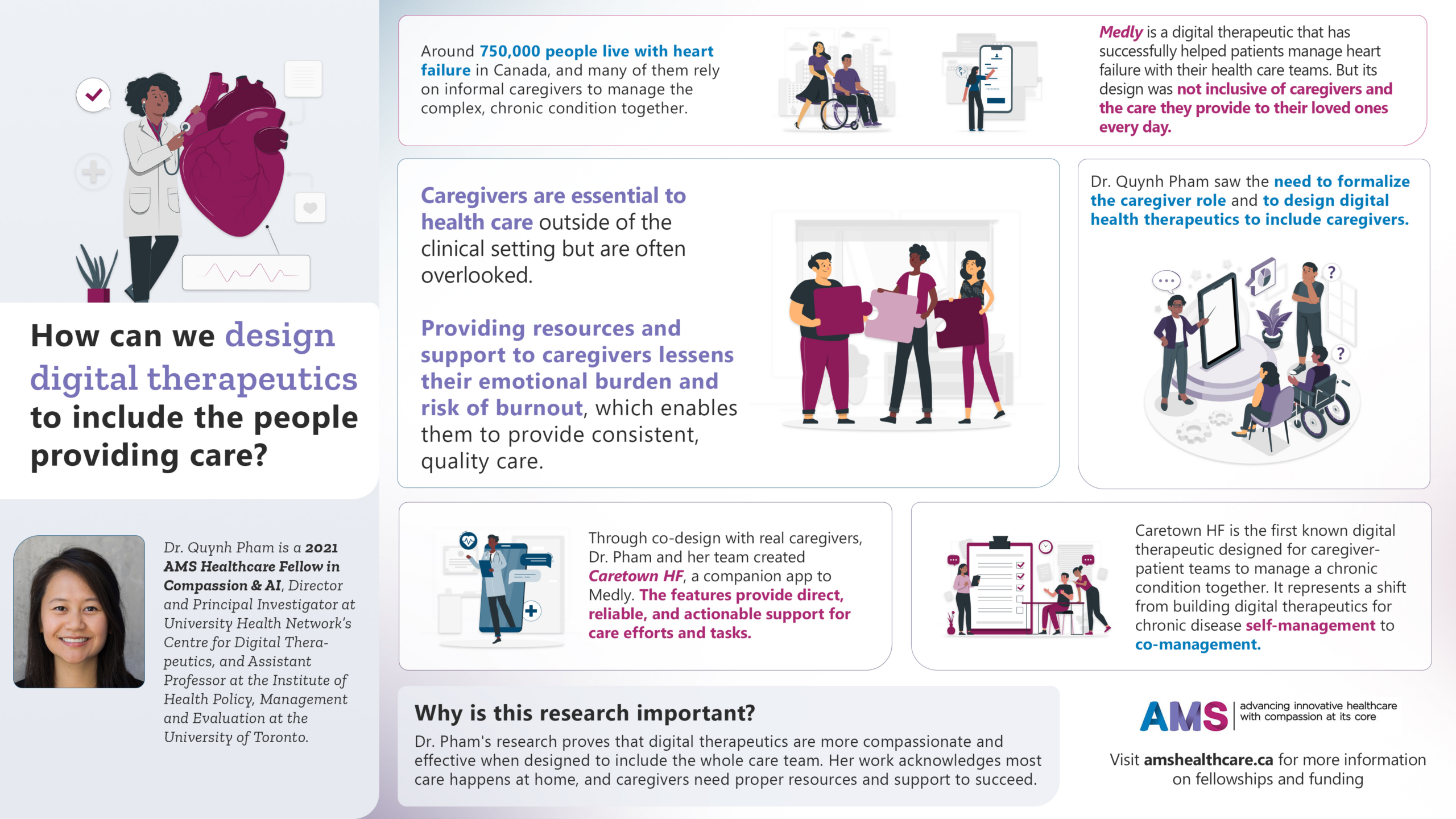
Every day, 750,000 people in Canada manage one of the most challenging chronic conditions.[1] Heart failure is a condition where the heart cannot pump blood effectively enough to meet the body’s needs. It is incurable and requires on-going daily management. What the statistics fail to capture is that managing heart failure is rarely a solo endeavour. The caregivers behind every patient are critical in navigating the illness with them. Yet, despite the essential impact informal caregiving has on patient outcomes and quality of life, it remains largely unaccounted for within the healthcare system.
Heart failure is unpredictable and worsens over time, leaving both patients and caregivers to face deep uncertainty. Caregivers, many of whom who do not have formal training, struggle to find reliable information and support to understand heart failure management. This lack of clarity and emotional burden leave caregivers at high risk of burnout which can reduce their ability to provide consistent, quality care. Recognizing this gap, Dr. Quynh Pham set out to understand how digital therapeutics can support caregiver-patient pairs and be designed to co-manage heart failure together.
Dr. Pham is a 2021 AMS Healthcare Fellow in Compassion and Artificial Intelligence (AI) and the Director and Principal Investigator at University Health Network’s Centre for Digital Therapeutics. Her research program investigates and develops digital therapeutics to support patients and their families to manage chronic diseases and well-being. To answer her question, she first looked at Medly, a prescription-based digital therapeutic for heart failure. In clinical settings, like the University Health Network, it is already being used by over 1000 patients. When patients submit their daily symptoms, Medly categorizes them into green (no action), yellow (caution), and red (urgent) alerts. Nurses will intervene for the latter two types of alerts.
Dr. Pham and her team found that Medly reduced uncertainty and provided reassurance through its features of regular check-ins, accessible and direct support to health care professionals, health and symptom tracking, and medical knowledge and guidance related to a patient’s daily status. However, Medly is a patient-facing tool, and while caregivers are instrumental in the success of managing heart failure, medication adherence, and coordinating care, they were still being left in the margins.
Caregivers are the backbone of health care outside of the clinical setting, but they are still overlooked. In fact, if a value were to be assigned to informal caregiving in Canada, it would be estimated between $97 billion and $113 billion annually.[2] Dr. Pham saw the need to formalize the caregiver role in digital health interventions and seized the opportunity to expand the Medly experience to complement and include caregivers as co-users. But before creating this new tool, Dr. Pham and her team needed to understand the dynamics and nuances of caregiver-patient relationships.
The relationship between a caregiver and patient is similar to a driver and passenger going on a road trip. One may do more driving while the other supports as needed, or both may take turns driving and navigating. This was reflected in the three types of caregiver-patient pairs Dr. Pham and her team observed. Patient-oriented pairs involve the patient performing most of their care tasks and maintaining a higher level of independence with the caregiver providing support as needed. In caregiver-oriented pairs, the caregiver undertakes a greater amount of support including daily and care tasks. The patient is more dependent on the caregiver. Lastly, the collaboratively oriented pairs share care tasks between the caregiver and patient in a balanced approach.
“Compassion isn’t something you sprinkle on at the end of development. It must be designed in from the first wireframe, and that means formally recognizing everyone involved in a patient’s care,” said Dr. Pham.
Understanding the types of caregiver-patient relationships is important before entering co-design because digital health solutions are not a one-size-fits-all. Designing a digital therapeutic without the end-users’ input or in mind is like building a GPS that ignores the roads people actually drive on. It is critical to understand the real-world context of patients and caregivers’ daily challenges, routines, and realities. Furthermore, co-designing increases accessibility, usability, and a sense of ownership that empowers users to integrate the solution into their lives.
Through interviews with caregivers, Dr. Pham and her team identified 6 features that would support their care efforts:
- Live reports with data sharing to facilitate better support
- Care cards that provide actionable tips and education
- Direct messaging with clinical staff
- Medication wallet that helps manage and explain medication regimens
- Medical events timeline of significant events and self-entries
- Caregiver resources on heart failure and caregiving self-care
These features became the foundation of , the companion to Medly. It underwent rigorous testing and yielded high usability. Caretown HF will be entering a randomized controlled trial soon as the first known digital therapeutic specifically built for caregiver-patient pairs managing a chronic condition together.
“Chronic disease is rarely managed alone, so why do we keep designing technology as if it were? Caretown HF starts from the premise that care is shared, and that our digital therapeutics should be shared too if they are to have real and lasting impact for patients and their families,” explained Dr. Pham.
Dr. Pham’s research on Medly and Caretown HF signals a fundamental shift in how digital therapeutics should be developed: from for users to with users. Her work underscores the importance of facilitating compassion in inclusive design by formally integrating family members and caregivers involved in a patient’s journey. The Caretown framework continues to be applied and expanded to other health conditions and culturally grounded digital health therapeutics. In reimagining how digital therapeutics are built and for whom, Dr. Pham’s work not only reduces burdens on health systems but also reaffirms that health technologies must reflect the heart of care.
Since her AMS Healthcare Fellowship in Compassion and AI, she has continued to expand her scope of research to how AI-enabled digital therapeutics can be designed to provide culturally compassionate care. Her team and her are co-designing AI care companion powered by large language models to support cardiac arrest survivors and their families through recovery and youth living with cancer pain and their family caregivers. They are also developing methods to automatically evaluate whether clinical AI models communicate with the compassion patients deserve.
“As AI starts to drive clinical care, my question is whether these systems can communicate with the compassion patients and families deserve. I want to prove that intelligent technology and human connection are not in tension. When we design well, each strengthens the other.”
1 Heart & Stroke Foundation of Canada. Falling Short: How Canada Is Failing People with Heart Failure—and How We Can Change That: 2022 Spotlight on Heart Failure. Heart & Stroke Foundation of Canada, 2022, https://www.heartandstroke.ca/-/media/pdf-files/canada/2022-heart-month/hs-heart-failure-report-2022-final.pdf.
2 Fast, Janet, et al. “Valuing the Contributions of Family Caregivers to the Care Economy.” Journal of Family and Economic Issues, vol. 45, 2024, pp. 236-249, https://doi.org/10.1007/s10834-023-09899-8.
Dr. Quynh Pham is Director and Principal Investigator at University Health Network’s Centre for Digital Therapeutics and Assistant Professor at the Institute of Health Policy, Management and Evaluation, University of Toronto. As an AMS Healthcare Fellow in Compassion and Artificial Intelligence, she designs and evaluates digital therapeutics that help people with chronic conditions and their caregivers manage care together. Her AMS-funded Caretown project reimagines chronic disease management as shared care, ensuring technology strengthens rather than replaces the human connection at the heart of caregiving.
Read Dr. Quynh Pham’s Publications:
El-Dassouki N, Pfisterer K, Benmessaoud C, et al. The Value of Technology to Support Dyadic Caregiving for Individuals Living With Heart Failure: Qualitative Descriptive Study. J Med Internet Res. 2022;24(9):e40108. Published 2022 Sep 7. doi:10.2196/40108
Benmessaoud C, Pfisterer KJ, De Leon A, et al. Design of a Dyadic Digital Health Module for Chronic Disease Shared Care: Development Study. JMIR Hum Factors. 2023;10:e45035. Published 2023 Dec 25. doi:10.2196/45035
Xiong T, Benmessaoud C, Pfisterer KJ, El-Dassouki N, Lohani R, Young K, Pham Q. Applying the blended KTA-Sprint framework to a usability assessment of a digital health module for informal caregivers co-managing heart failure. Hum Factors Healthc. 2024;6:100081. doi: 10.1016/j.hfh.2024.100081.
[1] Heart & Stroke Foundation of Canada. Falling Short: How Canada Is Failing People with Heart Failure—and How We Can Change That: 2022 Spotlight on Heart Failure. Heart & Stroke Foundation of Canada, 2022, https://www.heartandstroke.ca/-/media/pdf-files/canada/2022-heart-month/hs-heart-failure-report-2022-final.pdf.
[2] Fast, Janet, et al. “Valuing the Contributions of Family Caregivers to the Care Economy.” Journal of Family and Economic Issues, vol. 45, 2024, pp. 236-249, https://doi.org/10.1007/s10834-023-09899-8.