Designing compassion: Digital features that enable compassionate grief support
Lydia Sequeira
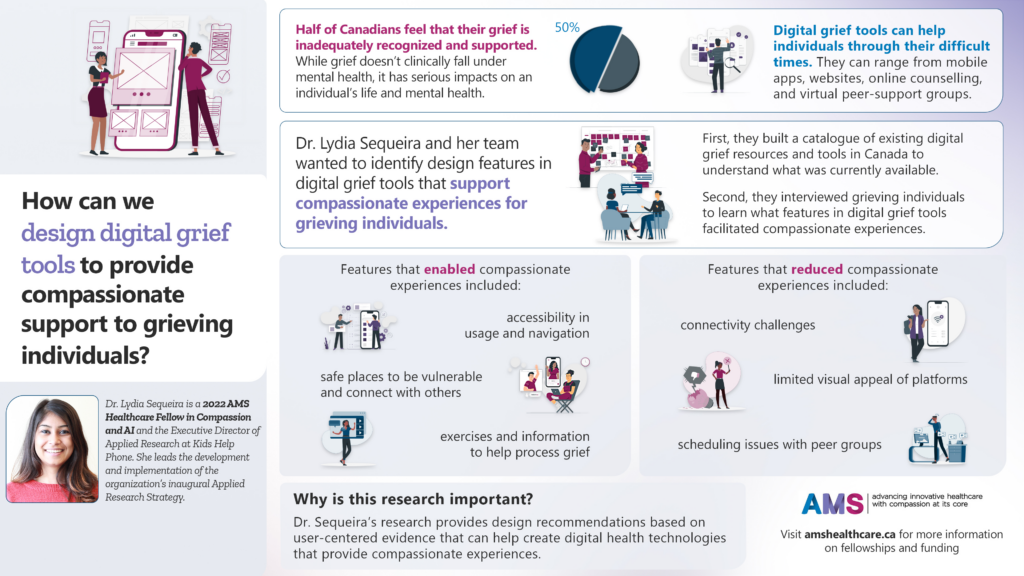
Despite grief being a universal, inevitable experience, roughly half of Canadians feel that their grief is inadequately recognized and supported.[1] In 2020, Dr. Lydia Sequeira was one of them. In the months following the loss of three friends, she did what many of us would do—look for resources and help.
“I tried reaching out to a few different organizations and looked for support tools for my friends and loved ones. I had some really challenging experiences with finding support for them, and at times, it felt very uncompassionate,” said Dr. Sequeira, 2022 AMS Healthcare Fellow in Compassion & AI and Executive Director of Applied Research at Kids Help Phone.
Since the COVID-19 pandemic, there has been a boom in the number of digital mental health tools. The growth of digital grief resources also mirrors this trend. However, grief occupies an undefined space in health care, where it’s serious enough to derail someone’s life and impact their mental health, but not always clinical enough to fall under formal mental health care.
As a scientist with experience building and designing mental health tools, Dr. Sequeira began to question how digital grief tools should be designed to provide compassionate support. She decided to find out with her 2022 AMS Healthcare Fellowship in Compassion and AI.
To start, Dr. Sequeira and her research team built a catalogue of digital grief resources and tools in Canada to map out the landscape. They ranged from apps and websites to online counselling services and virtual peer-support groups. Not only did the catalogue help her team understand what was available, but it also laid the groundwork for improving awareness and accessibility of grief resources nationwide. Next came learning about what features made grief support tools feel compassionate.
“I was curious to know what aspects allowed compassion to flow through and what made these digital grief tools more practical. If you are building a tool, especially something to help someone with their grief, what are the things that actually made them useful?” she shared.
Dr. Sequeira and her team interviewed 19 bereaved individuals who had used digital grief tools to identify what features enhanced and diminished compassionate experiences. Participants spoke on how features that enabled active listening, emotional validation, and empathetic communication facilitated compassionate experiences. Features that enabled these characteristics in digital grief tools included accessibility in usage and navigation, safe spaces to be vulnerable and connect with others, and interactive, structured exercises and information that supported processing their grief. On the other hand, participants cited that there were a couple features that eroded a compassionate experience. Those included connectivity challenges to the digital tools, limited visual appeal of certain platforms, and scheduling challenges with peer groups.
At first glance, Dr. Sequeira’s work focuses on digital grief tools, but her findings apply to digital mental health care tools overall. In a time where digital health tools are proliferating faster than our ability to evaluate them, her design recommendations offer user-centered evidence to ensure that the human element isn’t lost.
“Technology companies, researchers, and anyone building and implementing these tools can use these research findings to create compassionate health technologies. It’s an easy checklist that people can pick and choose that applies to most of them,” she said.
Dr. Sequeira expressed that the AMS Healthcare Fellowship gave her the invaluable opportunity to join a community working on compassionate AI and health technologies, learning alongside peers across disciplines. Since the fellowship, she has moved to Kids Help Phone and worked on the redesign, development, and implementation of Resources Around Me—a digital product that helps youth and caring adults across Canada access one of the country’s most comprehensive databases of wellbeing supports. Dr. Sequeira continues to work at the intersection of mental health, accessibility, research, and real-world implementation in the inaugural Applied Research department at Kids Help Phone.
Dr. Lydia Sequeira, PhD is the Executive Director of Applied Research at Kids Help Phone. She leads the development and implementation of the organization’s inaugural Applied Research Strategy. In her research and work, Dr. Sequeira collaborates with researchers, scientists, and youths to co-design and evaluate youth mental health products and services.
Dr. Lydia Sequeira’s Acknowledgements:
This AMS Healthcare Fellowship project would not have been possible without the support of several people. Dr. Sequeira would like to acknowledge and express gratitude to the following collaborators and members of the research project:
Supervisor: Dr. Gillian Strudwick
Mentor: Dr. Susan Cadell
Research Assistant: Sridevi Kundurthi
Collaborators: Dr. Nelson Shen, Emma Payne, Melissa Lunardini
Lived Experience Advisors: Faith Rockburn, Hajar Seiyad
[1] Canadian Grief Alliance. (2024, May 21). National Public Consultation on Grief: Executive Summary. Canadian Grief Alliance. https://aboutgrief.ca/media/gqodnber/2024-05-16-cga-grief-survey-executive-summary_fin.pdf